Exactly How Are Peptides Examined? Hplc, Coa & Pureness Clarified 2026
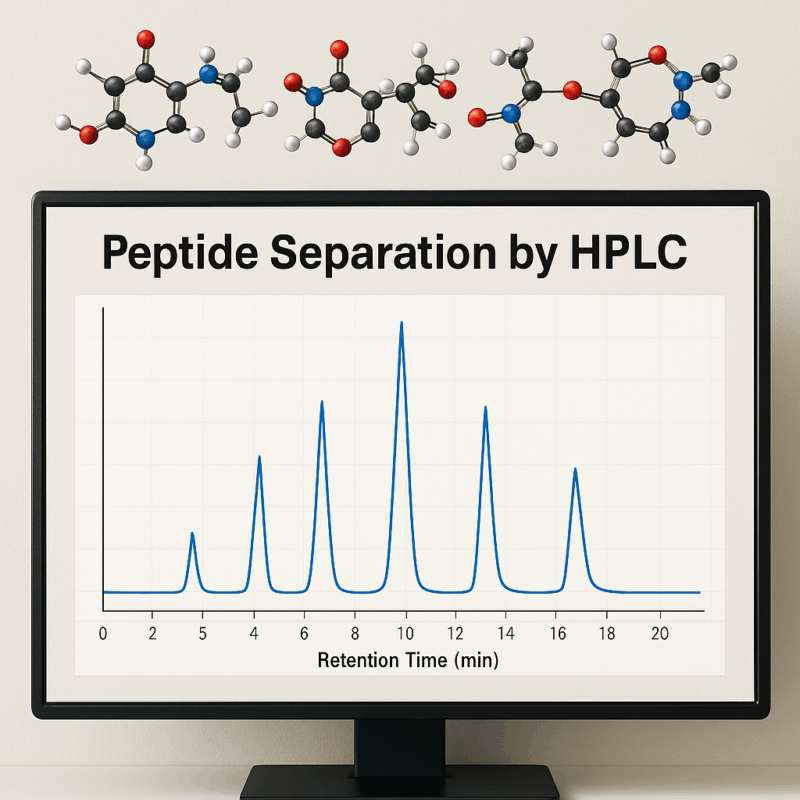
Hplc Research Laboratory, Hplc Screening Solutions Northeast Biolab Partial peptide pieces can result from incomplete synthesis or post-synthesis degradation. These fragments are normally smaller sized than the target peptide and might elute at various retention times. HPLC can show the existence of additional tops; LC-MS can aid appoint likely identifications to those related types. A strong peptide testing operations uses approaches that respond to complementary questions. The table below is the sensible way to consider typical examinations when reviewing a peptide COA. The example is injected into the system; as it travels with the column, different components elute at various times and appear as distinctive peaks on the chromatogram. A peptide's HPLC analysis normally produces a chromatogram showing one dominant peak (the target peptide) and potentially smaller sized peaks for impurities [3] Checking out an HPLC chromatogram includes noting each height's retention time and location. The location of the major peak about the overall area mirrors the peptide's pureness (e.g. a major height that is 98% of the overall location indicates the sample is 98% pure) [5] Scientists closely check out HPLC results to decide if a peptide is suitable for use.
Peptide Testing: Hplc & Mass Spectrometry Pureness Verification
Any references to research findings, medical studies, or prospective applications are offered solely to inform the clinical area and do not make up medical insurance claims.
The buddy web page on why 99 percent purity matters describes why small pollutant percentages can still matter in sensitive in-vitro assays.
Our solutions include HPLC and mass spectrometry testing to ensure that peptides fulfill research-grade needs.
Keeping that being said, developing peptides can be tricky since they deteriorate conveniently and are unbelievably conscious environmental conditions.
Purity is calculated by splitting the major peak area by the overall incorporated location of all UV-absorbing optimals.
As the medication advances in the next phase, nevertheless, it becomes crucial to maximize the method and make it more reproducible. HPLC method recognition comes to be necessary when Tox research studies are prepared for preparing IND application declaring. Therefore, we should focus on robust HPLC approach advancement and evaluation even throughout the earlier phases. In this manner, the approaches utilized in preclinical stage can be seamlessly transferred to the medical programs and would not require considerable HPLC approach advancement and validation. Peptide pureness figures out just how much of a sample has the desired series compared to various other chemical or biological species. High purity is important for reproducible experiments, accurate biochemical dimensions, and reputable regulatory submissions.
Why Purity Issues In Research
How much does peptide HPLC testing expense?
The price of peptide analysis solution differs dramatically based upon which strategies your governing bundle requires: HPLC-UV Analysis: $& #x 24; 300 & #x 2013; & #x 24; 800 per example (conventional pureness analysis) LC-MS (Fluid Chromatography-Mass Spectrometry): $& #x 24; 600 & #x 2013; & #x 24; 1,500 per sample (molecular weight verification).
Use AAA, CE, or peptide mapping to reinforce the logical package when much deeper confirmation is required. Lots of on the internet peptide vendors do not supply Certificates of Analysis, and others provide COAs without independent verification. Just distributors making use of third-party laboratory screening offer dependable top quality documentation. All peptides offered by Peptides Laboratory UK are strictly for research laboratory research study objectives only. They are not meant for human consumption, medical usage, or aesthetic application. To confirm your COA go to any of our item pages-- scroll down and duplicate the batch number, then visit optimalabs.org to verify. An unique approach to identify the absolute variety of moles of a substance from peak location dimensions making use of HPLC with a UV-- vis detector has been proposed. This integrated technique enhances information quality, decreases authorization risk, and boosts confidence in research study verdicts. Using the appropriate mix of techniques guarantees reputable peptide characterization appropriate for both exploration work and formal governing entries. Peptides Lab UK supplies research-use-only lab referral substances with batch-specific certificates of evaluation. Once the product is authorised, the compliance pressure morphs from a worry of demonstration to a concern of upkeep. The yearly item review should demonstrate that the validated technique remains to function as expected within its analytical guardrails; discrepancies require restorative actions that are in turn investigated. Method transfer to a contract organisation needs side-by-side equivalence studies, since the regulators will decline a brand-new lab simply asserting that it is using "the very same" column and mobile phase. Lastly, the recent development of formal ICH Q14 standards on analytical procedure development is promoting a lifecycle method in which validation is no more an one-time difficulty yet a living file continually refined by real-time data. Thus regulative compliance is not an external charge grafted onto peptide scientific research; it is the official language through which logical rigour is converted right into person defense and commercial sturdiness. A specialized union of biochemists and clinical Pharmaceutical Manufacturing scientists focusing on innovative peptide synthesis and medicinal applications. Our research study team curates evidence-based content on peptide scientific research, making sure all posts are based in peer-reviewed literature and present clinical understanding. Measurable results in high-performance fluid chromatography (HPLC) are typically based upon calibration with requirements and peak-area dimension. The System Viability Examination (SST) is made use of to confirm that a logical approach was suitable for its intended purpose of the day for the evaluation was done. It is a crucial specification to make certain the quality of the procedure for appropriate dimensions. System suitability verifies that the system is working perfectly prior to the analysis on HPLC or any type of other system, and it is required to be done prior to every example evaluation. Peptide purity describes the percentage of the desired peptide about all obvious elements in an example. Impurities originate from synthesis faults, degradation, incomplete deprotection, abbreviated variants, oxidation, or sample handling. Ion chromatography can likewise separate ionic compounds, ion-exchange separation modes, and inorganic anions or cations. Our tasks with NorthEast BioLab include successful method growth, recognition, stability studies during Medical Phase I-- IV studies. All Peptide Research compounds discussed in this article are meant purely for in-vitro research study and laboratory use just. They are not intended for human intake, vet use, or any kind of professional application. Scientists are accountable for making certain compliance with all relevant policies in their jurisdiction. Reversed-phase chromatography offers the fastest picture of relative purity. This batch-to-batch confirmation offers quality control across time and makes certain researchers have docudrama proof for every order they place. In easy terms, HPLC is exactly how researchers confirm that a peptide is clean, appropriately made, and worthwhile of count on. When you see peptide pureness reported utilizing HPLC, it implies the item has been thoroughly examined utilizing among the most dependable quality-control approaches readily available. Pinnacle's How to Check out a Peptide COA overview goes through this procedure detailed.